

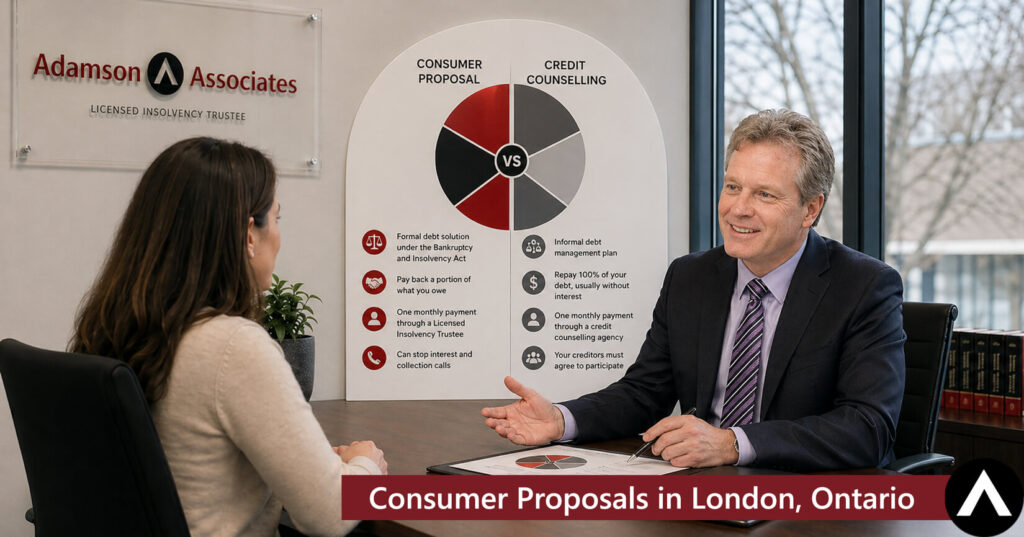
If your debts have become unmanageable, a consumer proposal may let you settle them without filing bankruptcy. You repay part of what you owe, in one monthly payment you can afford, and the collection calls stop.
Adamson & Associates has helped people across London and Southwestern Ontario resolve debt for more than 30 years, from our office at 1750 Ernest Avenue London, ON. The first consultation is free, confidential, and carries no obligation.
Call 519-310-JOHN (5646) or book online. Evening and late appointments are available.
What does a consumer proposal do for you?
Here is what changes for you, in plain terms:
- The collection calls stop. The day your proposal is filed, creditors must stop contacting you.
- Wage garnishments stop, and most lawsuits against you are halted.
- Interest stops on the debts included in the proposal. What you owe stops growing.
- You repay only part of what you owe, not the full balance.
- You keep your home and your vehicle, as long as you keep up the payments on them. You do not surrender assets to file a proposal.
- One fixed monthly payment, and it does not rise if your income does. Bankruptcy works the other way.
- Nothing extra to pay us. The trustee’s fee is set by a government tariff and comes out of that same monthly payment.
A proposal is legally binding on your creditors once accepted, including any who voted against it, and it ends: five years at most, and most proposals can be paid off early without penalty.
A consumer proposal is a legal debt settlement made under Division II of the Bankruptcy and Insolvency Act. Only a Licensed Insolvency Trustee can administer one in Canada.
What is a consumer proposal?
A consumer proposal is a formal offer to your unsecured creditors, prepared and filed by a Licensed Insolvency Trustee (LIT), to repay part of what you owe. Once creditors holding a majority of the dollar value accept the offer, it becomes legally binding on all of them, even the ones who voted against it.
That legal footing is what separates a consumer proposal from informal debt-relief plans. The moment your proposal is filed, a stay of proceedings takes effect under section 69.2 of the Bankruptcy and Insolvency Act: collection calls, most lawsuits, and wage garnishments must stop. A debt-management plan through a credit counselling agency has no such protection, and it cannot reduce the principal you owe.
The stay has limits, and honest advice includes them. It does not erase valid security over a home or vehicle, and some debts and proceedings receive different treatment under the law. John Adamson will explain exactly what protection applies to your situation before anything is filed.
What debts can a consumer proposal include?
- Credit cards and lines of credit
- Bank and finance-company loans
- Payday loans
- Tax debts owed to the Canada Revenue Agency
- Student loans, in some cases (generally where you ceased to be a student at least seven years ago)
Secured debts, such as your mortgage or a financed vehicle, are not included; you keep paying those as usual and you keep the asset.
Who qualifies for a consumer proposal in London?
Under the consumer-debtor provisions of the Bankruptcy and Insolvency Act, your total debts, excluding any debt secured by your principal residence, must be no more than $250,000. Note that this counts more than credit cards and loans: a financed vehicle or another secured debt still counts toward the limit, because only debt secured by your principal residence comes out of the calculation. You also need reliable income to fund the monthly payment, and you must be insolvent, meaning you cannot pay your debts as they come due. Couples whose debts are substantially the same may be able to file a joint consumer proposal.
How much does a consumer proposal cost in London?
There is no separate fee you pay to the Licensed Insolvency Trustee on top of your proposal. The trustee’s fee is set by a government tariff and comes out of the payments your creditors have already agreed to accept. In other words: you agree to one monthly payment, and that payment is all you pay.
What that monthly payment is depends on what you owe, what you earn, and what your creditors would receive in a bankruptcy, because creditors compare the two. In our experience administering proposals for London households, a well-prepared proposal typically offers creditors more than a bankruptcy would, while costing you significantly less than repaying everything with interest. Many people repay only a portion of their original debt; the reduction depends entirely on your circumstances, and no honest professional can promise you a specific number before reviewing your situation.
Use our consumer proposal calculator for a first estimate, then let us confirm it in a free consultation.
Is a consumer proposal better than bankruptcy?
Most people who walk into our London office believe bankruptcy is their only option. It rarely is. The differences that matter most:
| Consumer proposal | Bankruptcy | |
|---|---|---|
| Your assets | Generally kept, including home equity and vehicle | May be affected beyond Ontario’s exemptions |
| Payments | Fixed monthly amount, unchanged if your income rises | Surplus-income rules: payments can rise with income |
| Duration | Up to 5 years, can be paid off early | Typically 9 or 21 months for a first bankruptcy |
| Credit rating | R7, removed 3 years after completion or 6 years after filing, whichever comes first | R9, removed 6 years after discharge (Equifax) or 7 years (TransUnion, under Ontario’s Consumer Reporting Act) |
| Public record | Filed with the Office of the Superintendent of Bankruptcy | Same, and reportable in more circumstances |
Neither option is “better” in the abstract. Which one serves you depends on your income, your assets, and what you can sustainably pay. That assessment is exactly what the free consultation is for, and it is a conversation, not a sales pitch: if a proposal is not right for you, John Adamson will tell you so and explain what is.
Read more: Consumer proposal or bankruptcy: which is right for me?
How do you file a consumer proposal in London?
Knowing the mechanics removes most of the fear. Here is what the process looks like at our London office:
- Free consultation. Your first meeting is a fact-finding conversation, not a signing appointment. In person on Ernest Avenue, by phone, or by video: John Adamson’s team reviews what you owe, what you own, your income, and any urgent pressure such as a garnishment or lawsuit. Every option gets reviewed, not just a proposal; bankruptcy or credit counselling may fit better in some cases, and you will be told so.
- Building the proposal. If a proposal is the right fit, we calculate an offer your creditors are likely to accept, based on your budget and on what they would receive in a bankruptcy. Creditors weigh two things: whether the proposal returns more than a bankruptcy would, and whether the payment plan looks realistic. A payment that leaves no room for groceries, rent, and the unexpected is not workable, and we will not file one.
- Filing. The proposal is filed with the Office of the Superintendent of Bankruptcy. The stay of proceedings begins immediately: collection calls, most lawsuits, and wage garnishments stop.
- Creditor acceptance. Creditors have 45 days to review and vote. If creditors holding a majority of the dollar value accept (and most well-prepared proposals are accepted), the proposal binds all affected unsecured creditors.
- You make your payments. One monthly payment to the trustee, who distributes it to creditors. You also complete two financial counselling sessions, which are included.
- Completion. When the final payment is made, the remaining balance of the included debts is legally released, and you receive your Certificate of Full Performance.
Why do London residents choose Adamson & Associates?
- A Licensed Insolvency Trustee, regulated by the Office of the Superintendent of Bankruptcy. Consumer proposals can only be administered by an LIT; you are dealing with the licensed professional, not a referral service that hands your file to one later.
- 30+ years of experience helping individuals and families across London and Southwestern Ontario.
- John Adamson, CPA, CMA, CIRP, is the Licensed Insolvency Trustee you deal with, supported by a local team that has seen situations like yours before.
- A+ rating with the Better Business Bureau and 13 offices across Southwestern Ontario, so help stays local.
- Evening and late appointments for people who cannot step away during working hours.
“They are amazing there and very friendly I was struggling and they helped me get away from all the collection calls I couldn’t be happier thank you Adamson & Associates”
Becky Alden
Read more client testimonials.
Consumer proposal
Consumer proposal
Frequently asked questions
Will I lose my house or my car?
You do not surrender assets simply because you file a consumer proposal. To keep a financed home or vehicle you continue paying the secured lender as usual. The equity in your property is one of the factors creditors weigh when they assess your offer, which is another reason to have a Licensed Insolvency Trustee prepare it properly.
Can CRA tax debt be included?
Yes. Unsecured debts owed to the Canada Revenue Agency, including income tax and HST debts, can generally be included; the CRA participates as a creditor like any other. A registered lien or other secured claim changes the analysis, so tax debt should be checked before the terms are prepared.
What happens if creditors reject my proposal?
A rejection does not automatically make you bankrupt. The terms can often be amended, or another option considered, depending on why creditors objected and what your finances support. There is no honest way to promise acceptance before creditors review the filing; there is a well-prepared offer, which is the job.
What happens to my credit rating?
A consumer proposal is recorded as an R7 rating. Equifax removes it three years after you have paid off the debts under the proposal, or six years from the date you filed, whichever comes first; TransUnion applies a comparable rule. On a longer proposal it is usually the six-year date that arrives first. Most people filing a proposal have already missed payments, so the practical starting point is usually lower than people fear, and completing the proposal is the beginning of rebuilding.
Can I pay my proposal off early?
Yes. The term is a maximum, not a sentence. Most proposals allow extra payments or early payout without penalty, and many people finish early once their circumstances improve.
What if my income changes during the proposal?
Your payment does not increase if your income rises, unlike bankruptcy’s surplus-income rules. If your income falls and you cannot keep up, talk to us early; a proposal can be amended, but a proposal that falls three payments behind is annulled.
Is a consumer proposal public?
Proposals are filed with the Office of the Superintendent of Bankruptcy and appear in its public record search. In practice, no one is notified except your creditors; employers and landlords are not contacted.
These are the questions we hear most often at the London office. Read our fuller consumer proposal FAQ for more.
Talk to John Adamson’s London team
You do not need to have decided anything to come in. Bring your questions, get honest answers from a Licensed Insolvency Trustee, and leave knowing every option you have, whichever one you choose.
Read more about consumer proposals across Ontario.
Adamson & Associates, Licensed Insolvency Trustee
1750 Ernest Avenue London, ON N6E 3H3
519-310-JOHN (5646), with evening and late appointments available
Also serving Windsor, Chatham, Kitchener/Waterloo, and St. Thomas.
Book your free, confidential consultation
Reviewed by John Adamson, CPA, CMA, CIRP, Licensed Insolvency Trustee. Licence granted by the Office of the Superintendent of Bankruptcy Canada.