

Do you handle money differently than your family and friends? Are you ever surprised by…
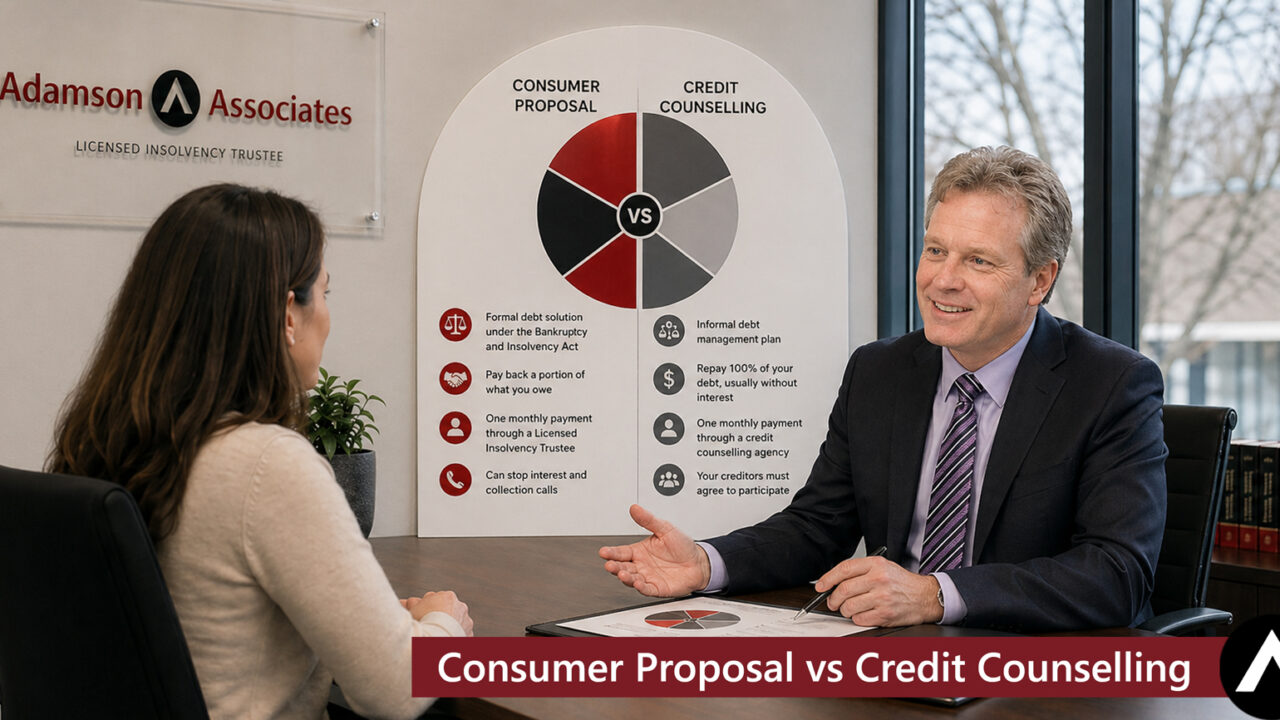
Consumer Proposal or Credit Counselling? How to Choose the Right Debt Solution in Ontario
A clear comparison of debt relief options and the specific role of credit counselling in your financial recovery.
Are you lying awake at night wondering what to do about your mounting debt? It’s a common worry in Ontario right now. With an ever-increasing debt-to-income ratio, many households feel like they are running on a treadmill that only goes faster.
Deciding how to fix this is one of the most significant financial choices you will ever make. While credit counselling and consumer proposals both aim to solve the same problem, they operate under completely different legal frameworks. In this current economic climate, understanding exactly how these two paths differ is the only way to protect your assets and your future.
The Fundamentals at a Glance
Before diving into the legal nuances, it’s helpful to understand the core differences between these two paths at a glance.
- Principal vs. Interest: A consumer proposal often allows you to settle for a portion of what you owe, whereas credit counselling generally focuses on repaying the full principal with reduced interest.
- Legal Protections: Only a consumer proposal provides a federal “Stay of Proceedings” to immediately stop wage garnishments and creditor lawsuits in Ontario.
- Updated 2026 Exemptions: Provincial law protects essential assets during a proposal, including one motor vehicle worth up to $8,578 and home equity up to $12,997.
- Debt Thresholds: Consumer proposals are a legal option for those with unsecured debts under $250,000, excluding their primary mortgage.
- Professional Oversight: While various agencies offer debt advice, only a Licensed Insolvency Trustee has the authority to administer legally binding settlements under the Bankruptcy and Insolvency Act.
What Is Credit Counselling? (The Debt Management Plan)
Credit counselling is typically offered by non-profit or for-profit agencies. Their primary tool is a Debt Management Plan (DMP).
In a DMP, the agency negotiates with your creditors to reduce or eliminate interest rates, but you are generally required to pay back 100% of the principal debt. You make one monthly payment to the agency, and they distribute the funds to your creditors.
The Reality of Credit Counselling:
Credit counselling is often a starting point for those who feel their debt is high but still within their control. The process rests on a voluntary agreement: you commit to repaying every dollar of your principal, and in exchange, your creditors typically agree to drop the interest.
However, this path requires a specific type of financial stability. Because it isn’t a federal legal process, it offers no shield against a creditor who decides to sue you or garnish your wages halfway through the plan. It’s a “good faith” arrangement that works best when your creditors are cooperative and your income is high enough to cover 100% of the debt over time. And if you hit a bump in the road, there’s no legal “stay” to fall back on. On top of that, your accounts in the plan are marked R7 on your credit report, which is one more cost to factor in.
What is a Consumer Proposal? (The Legal Settlement)
A consumer proposal is a formal, legally binding process under the Bankruptcy and Insolvency Act. It can only be administered by a Licensed Insolvency Trustee.
Unlike credit counselling, a consumer proposal often allows you to pay back only a portion of what you owe. The remaining debt is legally forgiven once the proposal is completed.
When a Consumer Proposal Becomes Necessary:
A consumer proposal is rarely someone’s first choice, but it becomes the logical move once the “math” of full repayment no longer adds up.
Unlike voluntary plans, this is a legally binding settlement that forces all unsecured creditors into the same deal, provided a majority agree. This “all-or-nothing” legal framework is what allows for an immediate stop to wage garnishments and the freezing of interest. For an Ontario resident, the choice is often driven by the desire to keep a home or car while resolving a debt load below the $250,000 threshold (excluding the mortgage).
The point isn’t to strip you of the basics. Ontario’s Execution Act protects one vehicle and a set amount of home equity, so you can settle a percentage of your debt through a proposal and still keep your household running.
Comparing the Two Solutions
| Feature | Credit Counselling (DMP) | Consumer Proposal |
| Principal Debt | You pay 100% of the debt. | You pay a portion of the debt. |
| Interest | Usually reduced or waived. | Stops completely. |
| Legal Protection | None. Creditors can still sue. | Automatic Stay of Proceedings. |
| Administrator | Credit Counsellor. | Licensed Insolvency Trustee. |
| Authority | Voluntary agreement. | Federal law (BIA). |
Why the Choice Matters in 2026
The current economic environment in Ontario has made “full repayment” plans difficult for many. Statistics from the Office of the Superintendent of Bankruptcy show that consumer proposals now account for approximately 80% of consumer insolvency filings in Ontario over the 12 months ending February 2026. This is largely because proposals offer a structured way to reduce the total debt load rather than just the interest rate.
It’s also important to note that only a Licensed Insolvency Trustee is authorized to provide a full range of debt solutions.While a credit counsellor can help with budgeting and DMPs, they are not legally permitted to file consumer proposals or bankruptcies.
How to Decide Which is Right for You
The right path depends on your specific financial “math.”
If you owe a relatively small amount and can afford to pay back the full principal if interest is removed, credit counselling might be a suitable first step. However, if your total debt exceeds your ability to pay back the principal within five years, or if you are facing a wage garnishment, a consumer proposal is often the more effective tool.
In Ontario, consumer proposals are limited to individuals with total debts of $250,000 or less, excluding the mortgage on their primary residence. If your debt exceeds this limit, other professional options are available.
Professional Guidance is Essential
Low payments alone won’t secure your recovery. Real stability demands absolute transparency. Operating within the parameters of the Bankruptcy and Insolvency Act requires a professional who understands the local Ontario exemptions and the specific requirements of the court.
A Licensed Insolvency Trustee will review your household budget, your assets, and your total debt to determine which solution provides the best path to a fresh start.
If you’re ready to compare these options based on your actual numbers, give us a call.
John Adamson, Licensed Insolvency Trustee, offers free, no-obligation consultations across Southwestern Ontario — London, Windsor, St. Thomas, Waterloo, Chatham, and beyond.
Call 519-310-JOHN (5646), day or evening. We are open late to help you.

Related Posts