
Every quarter the federal Office of the Superintendent of Bankruptcy publishes the official count of…
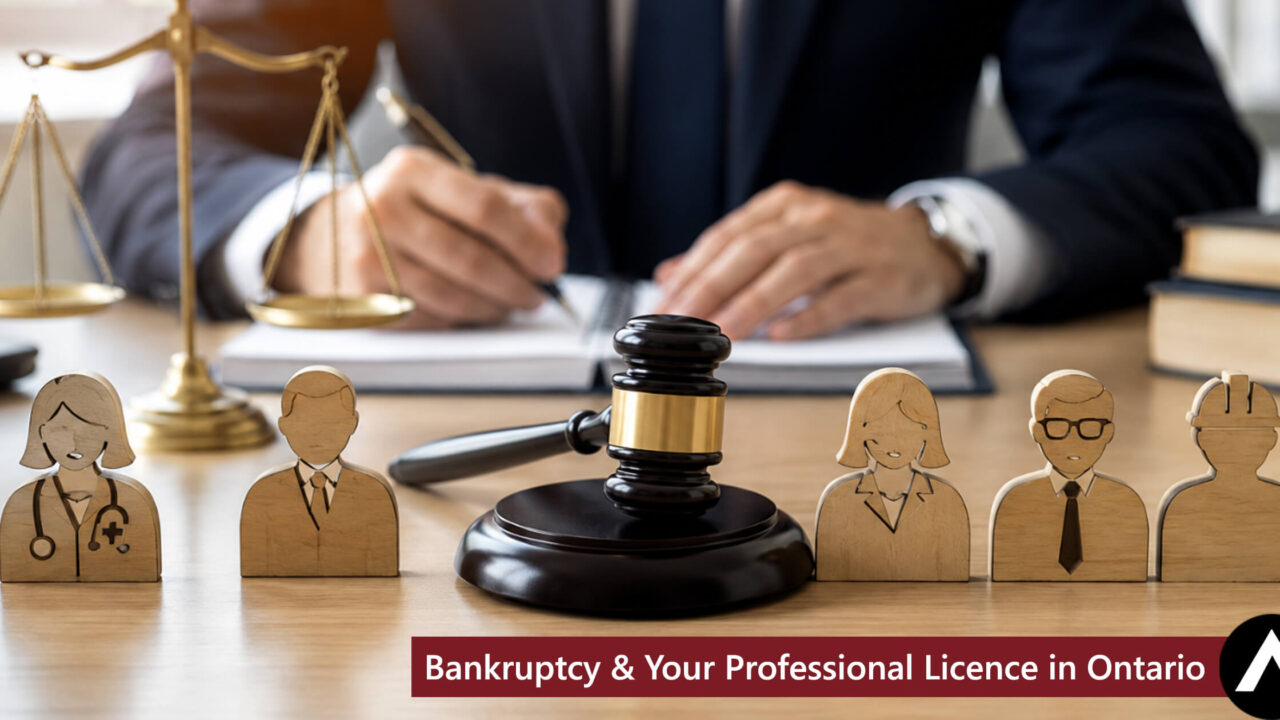
Bankruptcy and Your Professional Licence in Ontario
What Ontario Professionals Need to Know Before Filing
A bankruptcy or consumer proposal in Ontario does not automatically cancel most professional licences. But nearly every regulator requires disclosure, and some have mandatory timelines measured in days, not weeks. Real estate agents, mortgage agents, insurance agents, nurses, lawyers, and CPAs face different reporting rules. Speaking with a Licensed Insolvency Trustee early gives professionals a clear picture of both their insolvency options and their regulator obligations before anything is filed.
Financial stress hits professionals differently. We’ve sat across from nurses quietly drowning in tax debt, mortgage agents convinced a consumer proposal would end their career, and real estate brokers terrified a RECO disclosure would trigger discipline. The fear of losing a licence keeps people frozen long after the debt itself has become unmanageable.
Here’s what most people don’t realize: regulators are generally less concerned with the existence of a filing than with whether you were honest about it, and whether you remain fit to practise. A straightforward insolvency arising from divorce, illness, a business collapse, or a run of bad income years is treated very differently than financial misconduct involving client funds or dishonesty. That reframe changes things considerably.
We help Ontario professionals work through insolvency filings while managing regulator reporting requirements. This article provides general information only. Every regulator and professional circumstance differs. Always review your governing body’s current rules directly.
Quick Reference: Bankruptcy and Ontario Professional Regulators
| Profession | Regulator | Disclosure Required? | Licence Review Possible? |
|---|---|---|---|
| Real Estate Agents / Brokers | RECO | Yes — within 5 days of filing | Yes |
| Mortgage Agents / Brokers | FSRA | Yes — at renewal and upon FSRA request | Yes |
| Life Insurance Agents | FSRA | Yes — at renewal and upon FSRA request | Yes |
| Nurses (RN, RPN, NP) | College of Nurses of Ontario | Depends on circumstances | Yes, if conduct is involved |
| Chartered Professional Accountants | CPA Ontario | Yes — mandatory under Regulation 7-1 | Yes |
| Lawyers / Paralegals | Law Society of Ontario | Yes — typically mandatory | Yes |
Important: A licence review is not the same as a suspension or revocation. Regulators assess each situation individually. In many cases, professionals who disclose proactively and cooperate fully continue to practise without interruption.
What Do Ontario Regulators Actually Focus On?
This surprises most of the professionals we work with: the filing itself is rarely the whole story. What regulators care about, across almost every college and governing body, is conduct. Specifically:
- Was it disclosed on time?
- Were client funds involved?
- Is there a pattern of financial dishonesty?
- Does the debt situation create an ongoing conflict or risk for clients?
- Does the individual remain able to practise responsibly?
A nurse overwhelmed by medical debt after a family illness sits in a very different place than a lawyer whose trust account is short. So does a CPA who files a consumer proposal after a business failure, compared with one under investigation for fraudulent reporting. Regulators understand this. Most professionals who file honestly and disclose correctly face a review process, not the end of a career.
Does Bankruptcy Affect a Real Estate Licence in Ontario?
RECO and the Five-Day Rule
For Ontario real estate agents and brokers, the most important thing to know is this: disclosure to RECO is not optional, and it is not open-ended.
Under the Trust in Real Estate Services Act (TRESA), registrants are required to notify the Registrar within five days of filing for bankruptcy or a consumer proposal. The obligation continues even after a discharge. It must also be disclosed on any future registration applications.
Under normal circumstances, bankruptcy does not prevent registration and does not result in automatic revocation. RECO may place voluntary conditions on a registration, or request additional information, but the regulator’s primary concern is that registrants are honest about their financial circumstances. Late disclosure, or none at all, is the issue that tends to create real problems.
Can a Real Estate Agent File a Consumer Proposal?
Yes. Many do. Consumer proposals let registrants avoid bankruptcy outright while creating a formal repayment arrangement with creditors. For professionals concerned about optics, this can be a steadier path, though RECO disclosure still applies within the same five-day window.
We look at how bankruptcy and consumer proposals compare for licensed professionals in more detail below.
What About Mortgage Agents, Brokers, and Insurance Agents?
FSRA’s Suitability Framework
Mortgage agents, mortgage brokers, and life insurance agents in Ontario are regulated by FSRA. Disclosure of bankruptcy or insolvency is required, typically surfacing during annual licence renewal, and immediately if FSRA requests it.
FSRA’s assessment focuses on three things: the type of insolvency, how long ago it occurred, and whether there is a pattern of similar conduct. A single consumer proposal filed during a period of commission-based income instability reads very differently from repeated insolvency filings connected to client money.
The filing itself is not an automatic bar to licensing. We regularly see situations involving tax arrears, personal guarantees on failed businesses, or income disruption from economic downturns. These are situations FSRA contextualizes, rather than treats as disqualifying on their own. What matters is honesty, disclosure, and whether the professional’s conduct in relation to clients remains sound.
Does the College of Nurses of Ontario Care About Bankruptcy?
Personal financial difficulty and professional misconduct are not the same thing, and the College of Nurses of Ontario knows it.
CNO regulates nurses under the Health Professions Procedural Code, part of the Regulated Health Professions Act. Its fitness-to-practise and discipline processes are designed to protect the public from conduct that poses a risk to patient safety or reflects dishonesty in a professional capacity. Personal insolvency arising from circumstances outside the practice, such as illness, family crisis, or economic hardship, is not, on its own, the kind of matter CNO’s conduct processes are aimed at.
Where financial issues become relevant to CNO is when they intersect with professional conduct: fraud, misuse of workplace resources, or behaviour that raises questions about judgment or honesty in the practice setting. That’s a meaningfully different threshold.
For many nurses we’ve worked with, the relief that comes from finally stopping collection pressure, garnishments, and CRA enforcement has a direct effect on the quality of their practice. Getting the financial situation under control is itself a professional step.
Will CPA Ontario Revoke a Designation After Bankruptcy?
A Mandatory Disclosure Obligation
Accountants face the most specific and formal disclosure requirements of any profession on this list.
CPA Ontario’s Regulation 7-1, Section 27 requires members to notify the Registrar in writing upon:
- Becoming the subject of an application for a bankruptcy order
- Making an assignment for the general benefit of creditors
- Making or becoming subject to a Division I or Division II proposal under the Bankruptcy and Insolvency Act
- Having a business they control enter bankruptcy proceedings
This is a mandatory obligation, not a discretionary one. The disclosure must include supporting documents, or a written undertaking to provide them.
After disclosure, CPA Ontario may initiate a professional conduct review, request a written explanation, or impose monitoring requirements. The outcome depends heavily on context. A CPA who experienced a business failure, disclosed fully, and cooperated with the Registrar occupies a far stronger position than one facing allegations of financial dishonesty or client fund misuse. We strongly encourage CPAs to review their membership obligations with us before filing anything.
What Happens When a Lawyer or Paralegal Files for Bankruptcy?
Law Society Reporting
Lawyers and paralegals regulated by the Law Society of Ontario face mandatory reporting obligations when insolvency events occur. The LSO’s examination of a filing typically focuses on:
- Trust accounting records and client fund handling
- Outstanding judgments or enforcement actions
- Tax compliance
- Whether the financial circumstances affect obligations to clients or the administration of justice
LSO By-Law 9 governs lawyer trust accounts with particular strictness. Any insolvency situation that touches client funds, even indirectly, is treated more seriously than personal debt arising from circumstances outside the practice. A lawyer who has kept trust accounts clean, disclosed promptly, and cooperated with the Law Society stands in a far stronger position than one whose filing surfaces as part of a trust compliance issue.
Licence revocation is not a default outcome. Transparency, cooperation, and an absence of client harm are the factors that matter most.
How We Help Licensed Professionals Plan Before Filing
Most professionals come to us focused on the debt. The regulator piece catches them off guard.
What we actually do is help with both at the same time. Before any filing, we work through the disclosure obligations specific to your governing body, compare whether bankruptcy or a consumer proposal better fits your professional situation, and help prepare the documentation you may need to provide to your regulator. In many cases, the best outcome isn’t a formal insolvency filing at all. It’s getting cash flow under control, resolving a tax debt with CRA, or setting up an informal arrangement that doesn’t trigger a regulator review.
Professionals who address the problem early, before enforcement escalates, consistently have more options available to them. Garnishments grow. CRA gets more aggressive over time. Waiting rarely helps.
To learn more about finding the right Licensed Insolvency Trustee for your situation, see our guide for Ontario residents.
Bankruptcy vs. Consumer Proposal for Licensed Professionals
For most licensed professionals in Ontario, a consumer proposal is worth exploring before bankruptcy. Here’s why:
Assets are generally retained. The word “bankruptcy” doesn’t appear in the filing description the same way. Monthly payments are fixed and structured. And for regulators assessing suitability, a proposal can signal that the professional took a proactive step toward resolution rather than a last resort.
That said, consumer proposals are formal insolvency proceedings under the Bankruptcy and Insolvency Act. Disclosure obligations to your regulator apply equally, including RECO’s five-day window and CPA Ontario’s Regulation 7-1 requirement. The right choice depends on your debt type, income stability, tax exposure, the specific regulator involved, and whether any investigations are already underway.
We help you work through that comparison before anything is filed.
Questions to Ask Before Filing
Before filing bankruptcy or a consumer proposal, professionals should work through these questions:
- Does my regulator require disclosure, and is there a specific deadline? (For RECO and CPA Ontario, yes, and the timeline is short.)
- Do I handle client trust funds, or does my debt situation create a conflict?
- Are CRA or tax debts involved, and is enforcement already underway?
- Would a consumer proposal offer more professional stability than bankruptcy in my situation?
- Is there an allegation of professional misconduct already open with my regulator?
- Have I spoken with a Licensed Insolvency Trustee who has worked with professional clients before?
Where to Start
Fear is the thing that keeps people waiting too long. The earlier professionals seek proper advice, the wider the range of options. Once a garnishment is in place, or CRA has registered a lien, the choices narrow fast. A confidential conversation with a Licensed Insolvency Trustee costs nothing and carries no obligation. It simply gives you an accurate picture of what filing actually means for your licence, your income, and your professional standing before you commit to anything.
If you hold a professional licence in Ontario and are managing debt that has become unmanageable, we’re here to help you understand your options clearly.
Call John at 519-310-JOHN (5646) for a free, confidential consultation. Day or evening, we are open late to help you.
Contact Adamson & Associates to speak with a Licensed Insolvency Trustee. John Adamson, CPA, CMA, CIRP, LIT, is the principal Licensed Insolvency Trustee. He has helped Ontario professionals and individuals work through insolvency filings and regulator disclosure obligations for more than 30 years.
This article is provided as general information only and should not be relied upon as legal, regulatory, or professional licensing advice. Regulator rules change. Always consult your governing body directly for current obligations specific to your situation.

Related Posts