
Every quarter the federal Office of the Superintendent of Bankruptcy publishes the official count of…
Canadian Insolvencies Hit Highest Level Since 2009
What Rising Insolvency Numbers Reveal About Household Finances in Ontario and Across Canada
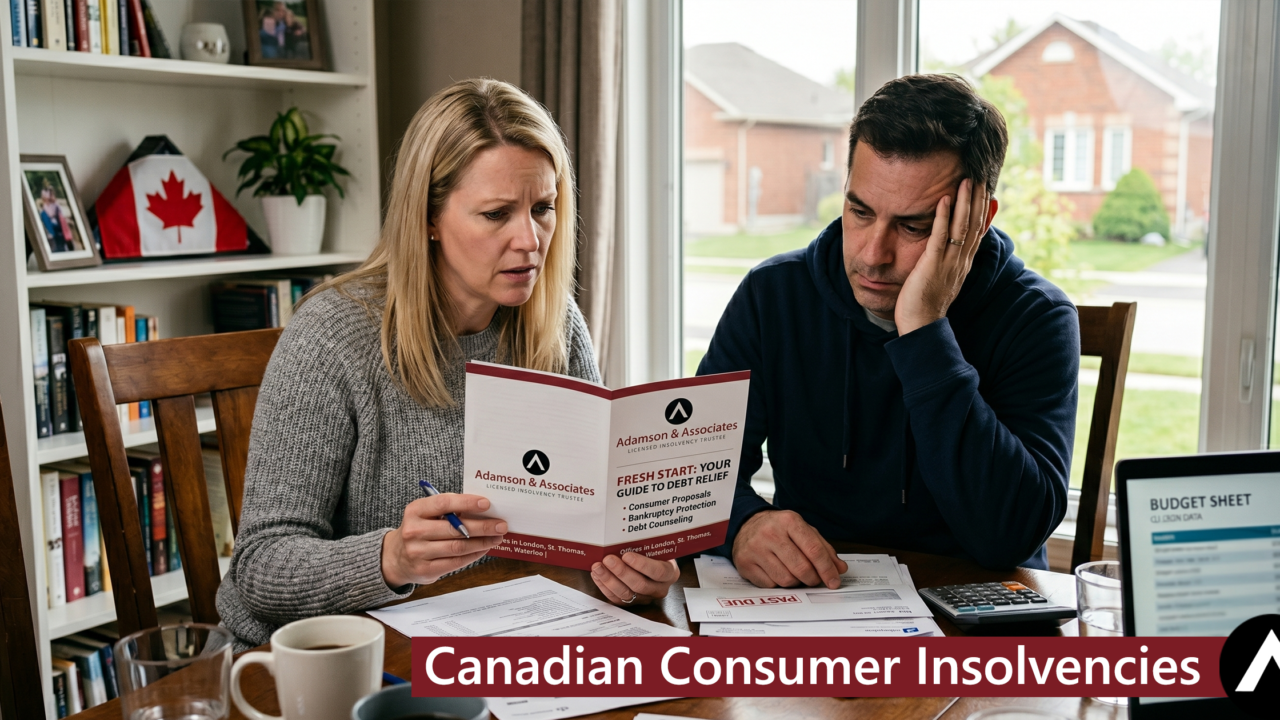
Consumer insolvencies in Canada reached their highest quarterly level since 2009 during the first three months of 2026. More than 37,000 Canadians filed a bankruptcy or consumer proposal in Q1 alone, driven by rising housing costs, higher borrowing expenses, and growing household debt. While the numbers are concerning, they also highlight an important reality: many Canadians are taking formal steps to regain financial stability before their situation becomes unmanageable.
The latest insolvency data paints a clear picture.
Canadians are under pressure.
We’ve spent years helping individuals and families navigate financial difficulties. What we’re seeing today feels different from the short-term disruptions of previous economic cycles. Many people seeking advice are employed, own homes, and have done what most would consider “all the right things.” Yet they still find themselves struggling under the weight of rising costs and debt obligations.
The newest reports from Equifax Canada, the Office of the Superintendent of Bankruptcy, and the Canadian Association of Insolvency and Restructuring Professionals (CAIRP) suggest this experience is becoming increasingly common.
Why Are Insolvency Filings Rising Across Canada?
The numbers are significant.
According to the Office of the Superintendent of Bankruptcy, 37,121 Canadians filed a consumer insolvency during the first quarter of 2026. That works out to approximately 17 insolvency filings every hour.
CAIRP reported that this represents the highest quarterly volume of consumer insolvencies since Q1 2009, during the aftermath of the global financial crisis.
Equifax Canada found insolvency volumes increased by nearly 19 percent compared to the same period in 2025.
This isn’t being driven by a single issue. Instead, several financial pressures are converging at the same time.
The Three Biggest Cost Pressures Facing Canadians
According to CAIRP, three expenses are showing up repeatedly in insolvency files:
- Housing costs
- Vehicle financing
- Food and grocery expenses
For many households, incomes simply have not kept pace with these rising costs.
A mortgage renewal at a significantly higher interest rate can add hundreds or even thousands of dollars to monthly expenses. Vehicle payments remain elevated due to higher financing costs and vehicle prices. Meanwhile, grocery bills continue to consume a larger share of household budgets than they did just a few years ago.
Why Are More Homeowners Filing Consumer Proposals?
One of the most interesting findings from the Equifax report involves homeowners.
Historically, insolvency filings were often associated with renters or individuals carrying high levels of unsecured debt.
That is changing.
Homeowner insolvency volumes increased by more than 11 percent from the previous quarter.
Even more telling, over 90 percent of these homeowners chose a consumer proposal rather than bankruptcy.
Why Consumer Proposals Are Becoming More Common
A consumer proposal is a formal debt settlement process administered by a Licensed Insolvency Trustee.
Many homeowners prefer this option because it may allow them to:
- Retain their home
- Consolidate unsecured debt
- Stop collection activity
- Eliminate interest charges
- Create a structured repayment plan
For individuals who have accumulated equity in their home but are struggling with unsecured debts, a consumer proposal can provide a practical alternative to bankruptcy.
Every situation is different, but the trend suggests many Canadians are actively seeking solutions before their financial challenges become more severe.
How Much Debt Are Canadians Carrying?
The debt numbers continue to climb.
Equifax reported that total consumer debt reached $2.66 trillion in Q1 2026, representing a year-over-year increase of 3.8 percent.
Among individuals filing insolvency proceedings, the average non-mortgage debt rose to approximately $43,300.
These figures reveal an important shift.
Many insolvency filings are no longer being driven by isolated financial mistakes. Instead, they often reflect sustained financial pressure over several years.
Missed Payments Are Increasing
Approximately 1.5 million Canadians missed at least one credit payment during the quarter.
Missed payments are often one of the earliest warning signs that financial stress is reaching a critical point.
Common indicators include:
- Using credit cards to cover necessities
- Paying only minimum balances
- Falling behind on tax obligations
- Borrowing to make debt payments
- Carrying balances month after month
When these patterns persist, debt can become increasingly difficult to manage without professional assistance.
What Does Government Debt Have to Do with Household Finances?
A separate report released by the Fraser Institute examined government debt levels across Canada.
The study found that combined federal and provincial net debt is projected to reach $2.44 trillion in 2025/26.
That figure has nearly doubled since 2007/08.
While government debt and personal debt are not directly connected, they often reflect broader economic realities.
Periods of persistent deficits can influence taxation, public spending, interest rates, and economic growth. These factors ultimately affect household budgets and consumer confidence.
Ontario’s Debt Burden Remains Significant
The Fraser Institute report estimated Ontario’s combined federal-provincial debt burden at approximately $63,574 per person.
Only Newfoundland and Labrador reported a higher per-capita figure.
At the same time, Ontario experienced one of the sharpest increases in mortgage delinquency balances, which rose by more than 50 percent year-over-year.
Taken together, these indicators suggest many Ontario households are facing substantial financial strain.
Is Canada Approaching a Financial Inflection Point?
Equifax described the current environment as a potential financial inflection point.
That phrase is worth considering.
For many Canadians, the question is no longer whether finances feel tighter than they did a few years ago.
They do.
The more important question becomes:
“How long can the current situation continue before meaningful action is required?”
We often speak with individuals who spent months, or even years, trying to solve debt problems on their own.
Some depleted savings.
Others refinanced homes.
Many transferred balances between credit cards.
Eventually, however, most reached a point where a structured solution became necessary.
What Should You Do If Debt Is Becoming Unmanageable?
If debt payments are consuming an increasing share of your income, taking action early generally creates more options.
Consider the following checklist:
Financial Stress Warning Signs
- ✓ Using credit for groceries or basic expenses
- ✓ Carrying balances that never seem to decrease
- ✓ Falling behind on tax obligations
- ✓ Missing payments or relying on overdraft protection
- ✓ Losing sleep over debt
- ✓ Avoiding creditor calls
- ✓ Borrowing from one source to pay another
The earlier these issues are addressed, the more flexibility typically exists.
The Bigger Story Behind the Numbers
The record insolvency figures reported in early 2026 are not simply statistics.
They represent thousands of Canadians making difficult financial decisions in response to rising living costs, higher borrowing expenses, and mounting debt.
What often gets overlooked is that insolvency proceedings are designed to provide relief and a path forward. Whether through a consumer proposal or bankruptcy, the goal is not punishment. The goal is financial rehabilitation.
For individuals facing overwhelming debt, understanding available options can be the first step toward regaining control and rebuilding financial stability.
Concerned About Your Debt Options?
If rising payments, mounting balances, or financial uncertainty are keeping you up at night, you’re not alone. You likely have more options than you think, and the sooner you understand them, the more choices you have.
At Adamson & Associates, we’re a locally owned firm with offices across Southwestern Ontario, including London, Windsor, Chatham, Kitchener/Waterloo, and St. Thomas. John Adamson and our team of Licensed Insolvency Trustees have helped people in our communities get a fresh start for more than 30 years.
Call John at 519-310-JOHN (5646) for a free, confidential, no-obligation consultation. Day or evening, we are open late to help you.

Related Posts